Buying Guides
Gyuto vs Santoku: How Japanese Makers Frame Your First Knife
Gyuto vs santoku at a glance (TOJIRO framing)
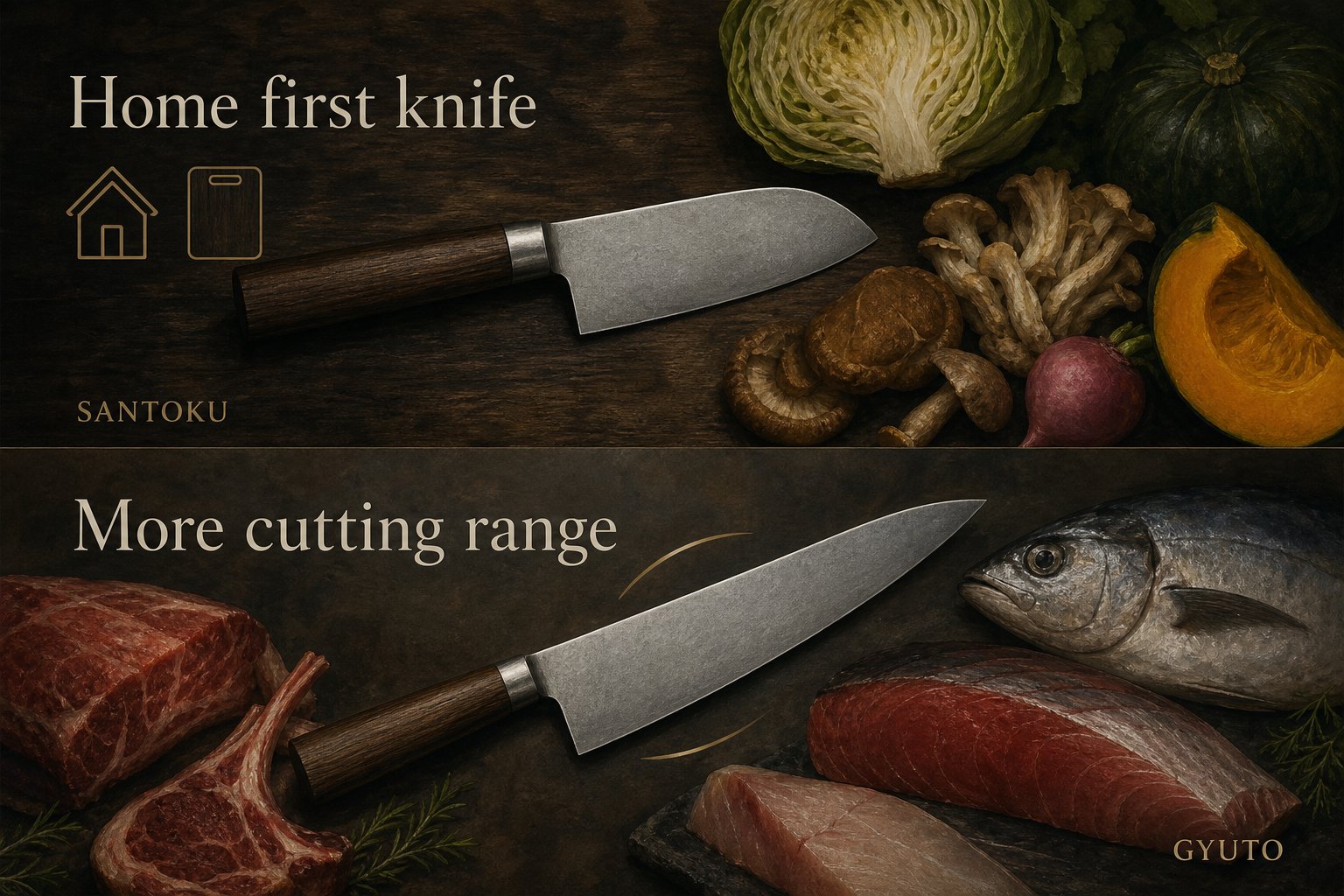
Japanese maker pages do not crown a “best” first knife by English ranking logic. Below is how TOJIRO describes the two sibling all-purpose profiles side by side — length, tip, edge line, and favored motion — so you can read shapes, not marketplace adjectives.
| Dimension | Santoku (per TOJIRO) | Gyuto (per TOJIRO) |
|---|---|---|
| Length (home) | About 165–180 mm; many makers offer a single size around 170 mm | Wider range (~180–240 mm on the type guide; household FAQ points to 18 cm or 21 cm) |
| Tip | Tip curves gently; formal name 三徳, everyday “santoku knife” | Sharper / more pointed tip; tip work called out as a strength |
| Edge / blade line | Relatively straight edge against the board; wider blade | Edge curves toward the tip; narrower blade height (maker comparison) |
| Favored motion | Push cuts / downward chopping; framed as home-kitchen main knife | Draw / push / swing cutting along the curve; framed as a versatile repertoire (including pro kitchens) |
Not a ranking. Both shapes sit in TOJIRO’s all-purpose category; the table attributes profile cues, not a purchase verdict from this site. Details: TOJIRO Knife types…, What is a santoku?, What is a gyuto?, What is an all-purpose knife? (Japanese; confirmed 2026-09-22).
Gyuto or Santoku — what are you actually choosing?
If you are buying a first Japanese kitchen knife in English, the comparison that keeps showing up is gyuto vs santoku. The labels sound exclusive — chef’s knife versus home all-rounder, meat versus vegetables — and ranking pages lean into that split. Most of that framing is marketing shorthand, not how Japanese maker pages describe the shapes.
What you are actually choosing is a blade profile: length, tip curve, how the edge meets a cutting board, and which cutting motions the maker says the shape favors. You are not choosing a ranking slot. This article stays on the maker pages.
If the anxiety underneath the purchase is “is this actually Japanese, or Japanese-style?”, that is a different question. Origin, steel story, and style language are separate claims; we already walk that split in What Does “Japanese” Mean on a Kitchen Knife?. Here the job is narrower: how do Japanese makers define gyuto and santoku, and which shape do they steer a first knife toward?
“All-purpose” is a category, not a blade shape
TOJIRO’s reading series is unusually blunt about a word English listings overuse. In What is an all-purpose knife? (Japanese; TOJIRO, accessed 2026-09-06), the company writes that there is no formal blade shape called “万能包丁” (all-purpose knife). In industry use it is not an official classification name. Product design treats it as a question of whether a shape covers a wide range of tasks. In short, “all-purpose knife” is a category label for highly versatile knives, not a shape SKU.
The same article then places both shapes inside that category: the domestic shorthand for “all-purpose” is often the santoku, and the Western-born gyuto is also one kind of all-purpose knife. Both cut meat and vegetables and portion dressed fish — “all-purpose” in the ordinary sense, not two rival specialties.
That is the thesis of this hub. Gyuto and santoku are sibling all-purpose profiles, not a vegetable knife versus a meat knife. The rest of the article is how TOJIRO and related maker pages flesh out each sibling — then how we read two live examples on this site.
What makers mean by Santoku
On TOJIRO’s Knife types and how to use them guide (Japanese; accessed 2026-09-06), santoku is the all-purpose knife that can handle the “three virtues” of meat, fish, and vegetables — and the maker calls it the main knife of the home kitchen.
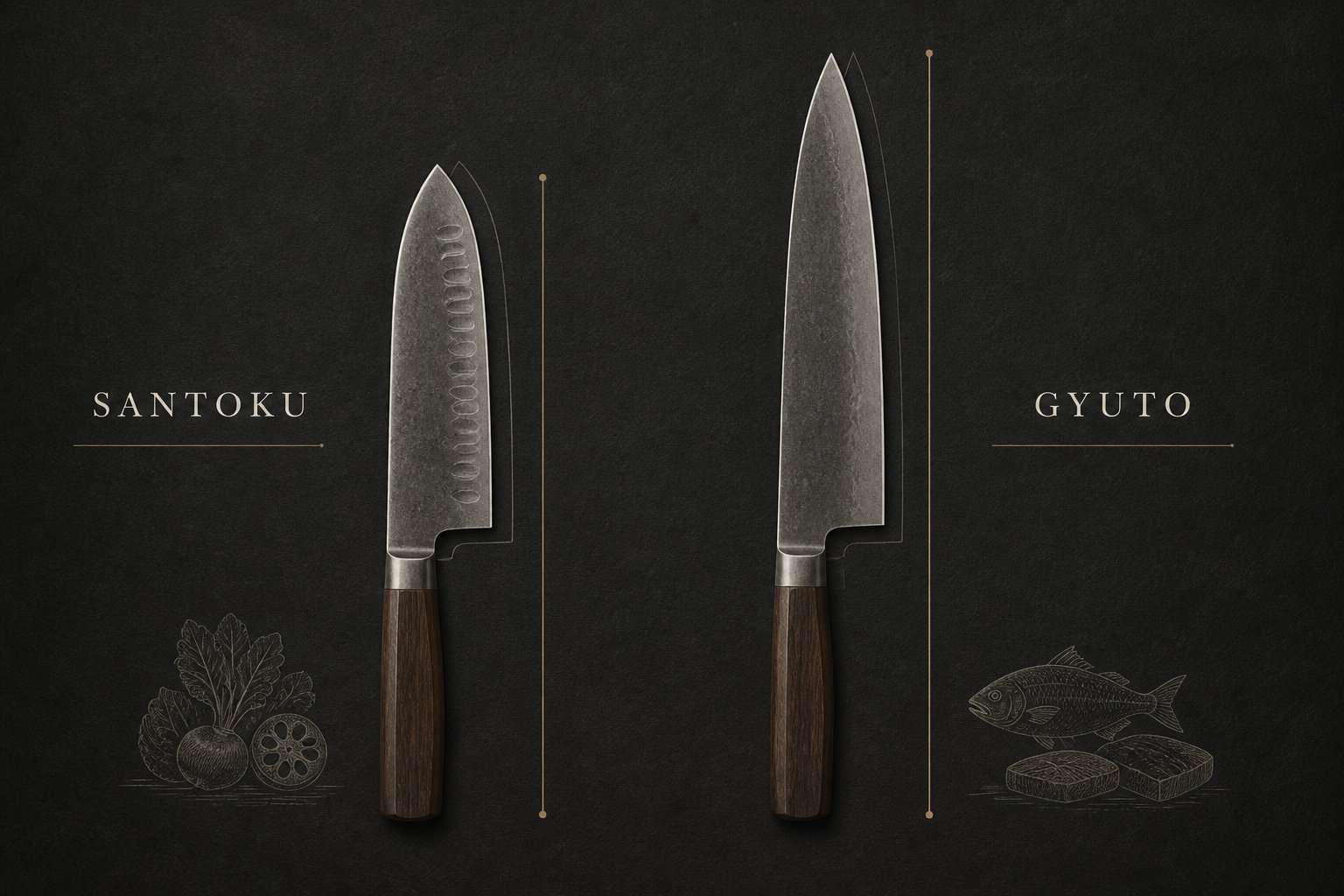
A dedicated santoku explainer (Japanese; TOJIRO, accessed 2026-09-06) repeats the household role: the santoku is the all-purpose knife most used in Japanese homes, named because it covers those three food types. The same page notes that the formal name is “三徳”; “santoku knife / 三徳包丁” is the everyday label the article uses for readers. Shape cues the maker emphasizes: blade length around 170 mm, a relatively wide blade, and a tip that curves gently.
Product copy matches the reading pages. On the PRO santoku product page (Japanese; TOJIRO store, accessed 2026-09-06), the shape note says the santoku can be used all-purpose for meat, fish, and vegetables — which is why it is also called an all-purpose knife — and that it is well suited to ordinary home use.
That is how one major Japanese maker consistently frames the shape for first-time and replacement buyers.
What makers mean by Gyuto
TOJIRO’s type guide calls the gyuto a more serious all-purpose profile: many sizes, suited to varied cutting methods matched to the food, and popular with professionals as well as home cooks (Knife types and how to use them, Japanese; accessed 2026-09-06).
The dedicated gyuto explainer (Japanese; TOJIRO, accessed 2026-09-06) opens with origin and naming: the gyuto is a Western-born all-purpose knife; in English it is called a chef’s knife or gyuto, and it works in kitchens worldwide. The same page kills the most common English-market myth in maker voice. Customers at TOJIRO’s own shops often ask whether a gyuto is meat-only. The company calls that a major misunderstanding: the gyuto is designed as an all-purpose knife for meat, fish, and vegetables.
Product copy repeats the point. On the CLASSIC gyuto page (Japanese; TOJIRO store, accessed 2026-09-06), the shape note says that because the gyuto is called a chef’s knife overseas, it is a general all-purpose knife and can be used for many kinds of cooking — not meat alone.
For home blade length, TOJIRO’s gyuto explainer FAQ (What is a gyuto?, Japanese; accessed 2026-09-06) recommends 18 cm or 21 cm for household use. That is a maker recommendation, not a universal industry rule — keep the subject line on TOJIRO when you use it.
Which way for a first knife?
TOJIRO answers the first-knife fork directly. In the type-guide FAQ (Knife types and how to use them, Japanese; accessed 2026-09-06), the company’s answer to “should the first knife be a santoku or a gyuto?” is choose the santoku — it covers meat, fish, and vegetables widely — while a gyuto is positioned for a step-up cutting repertoire or a second all-purpose knife.
Elsewhere on the same guide, TOJIRO positions the santoku as ideal for a first knife or a replacement main knife: food-agnostic, with a relatively straight edge line against the board that favors push cuts.
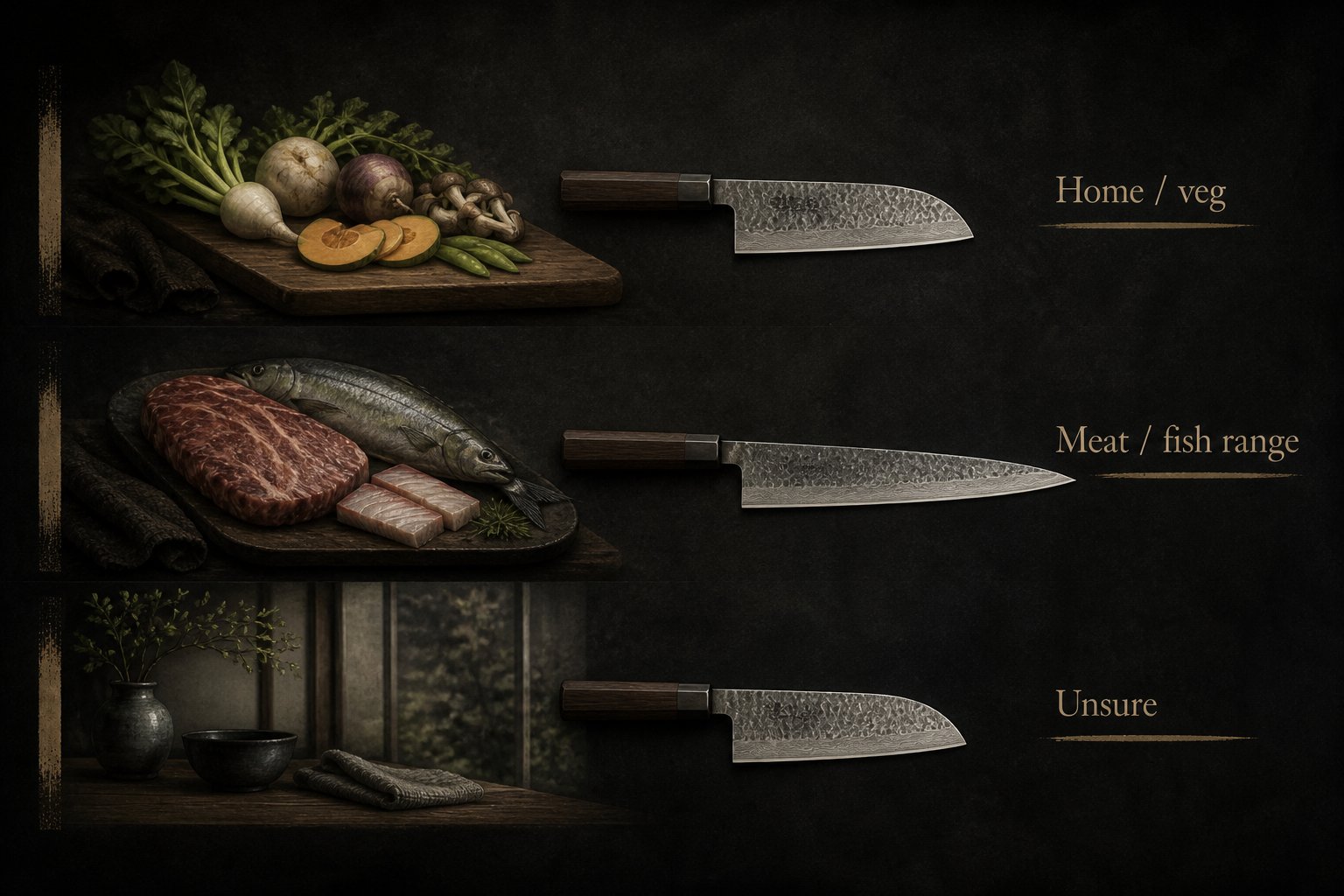
The all-purpose explainer (What is an all-purpose knife?, Japanese; accessed 2026-09-06) adds orientation checks, still in maker voice:
Santoku-leaning (per TOJIRO)
- Home cooking centered on vegetables
- Compact board or kitchen
- You do not want to overthink the choice
Gyuto-leaning (per TOJIRO)
- You cut meat and fish often
- You are used to draw cuts and push cuts
- You have a bit more counter space
Five checks before you pick a shape:
- Name the job, not the ranking. Are you replacing one home main knife, or adding a longer second blade?
- Read the maker’s shape note, not only the English marketplace adjective (“chef,” “vegetable,” “pro”).
- Match length to space. Santoku sizes cluster around 170–180 mm (TOJIRO puts most makers in that single-size range); TOJIRO’s household gyuto FAQ points at 18 or 21 cm.
- Keep both shapes in the all-purpose category. Do not invent “santoku = vegetables only / gyuto = meat only.”
- Park origin anxiety on the authenticity hub. Shape choice does not answer Made in Japan vs Japanese-style — What Does “Japanese” Mean…? does.
FAQ — first knife, “all-purpose,” and when gyuto
Should my first Japanese kitchen knife be a santoku or a gyuto?
On TOJIRO’s type-guide FAQ (“最初の1本は「三徳」と「牛刀」どちらがいい?”), the published answer is: if unsure, choose the santoku — it covers meat, fish, and vegetables widely; a gyuto fits a step-up cutting repertoire or a second all-purpose knife (Knife types and how to use them, Japanese). TOJIRO’s store FAQ (“初めて買う包丁にはどれがおすすめですか?”) likewise steers a first purchase toward a santoku as the representative all-purpose home knife (store FAQ, Japanese). This site surfaces that maker answer; it is not our own “buy X” ranking. English SERP pages often default to gyuto-first — that is marketplace habit, not TOJIRO’s published first-knife FAQ.
When does TOJIRO point people toward a gyuto instead?
Still in maker voice: when you want a wider cutting repertoire or a second all-purpose blade (type guide); when you often cut meat and fish, are used to draw and push motions, and have more counter space (all-purpose explainer); or when your cooking leans draw cuts / slicing / larger ingredients (TOJIRO’s gyuto FAQ: push-cut-centered → santoku; draw-slice-large → gyuto; both motions → gyuto can still push-cut near the heel) (What is a gyuto?).
Is “all-purpose knife” a blade shape?
No — per TOJIRO’s all-purpose explainer, there is no formal blade shape called 万能包丁 (“all-purpose knife”). Industry use treats it as a category label for highly versatile knives, not an official classification SKU. Both santoku and gyuto are described as members of that category (What is an all-purpose knife?).
Is a gyuto a meat-only knife?
TOJIRO calls that a major misunderstanding. Shop customers often ask; the maker states the gyuto is designed as an all-purpose knife for meat, fish, and vegetables. Product copy on the CLASSIC gyuto page repeats: general all-purpose use, not meat alone (What is a gyuto?; CLASSIC gyuto F-808).
Is a santoku only for vegetables?
No. TOJIRO frames santoku as the home main knife covering the “three virtues” of meat, fish, and vegetables, and as the shape most used in Japanese homes (type guide; santoku explainer). Vegetable-heavy home cooking is one orientation cue toward santoku, not a “vegetables-only” definition (all-purpose explainer).
What blade lengths does TOJIRO cite for home use?
Santoku: type-guide table 165–180 mm; the dedicated santoku page emphasizes ~170 mm and a common single-size range (type guide; santoku explainer).
Gyuto (household): FAQ recommends 18 cm or 21 cm (21 cm called a balanced home size that still shows gyuto traits; 18 cm for smaller hands / tighter kitchens / first gyuto anxiety) (What is a gyuto?).
Do English “chef’s knife vs santoku” rankings match Japanese maker framing?
Not reliably. Ranking pages often split “chef = meat / santoku = veg.” TOJIRO’s reading series puts both shapes in the all-purpose category and answers the first-knife FAQ toward santoku, with gyuto as repertoire step-up or second blade — profile and motion, not a ranked winner (all-purpose explainer; type guide).
Entry steel and the $150–400 band (without re-teaching origin)
Once the shape is clear, English shoppers usually hit two more questions: what steel am I buying into, and what price band is this site treating as an entry Japanese knife?
On steel, stay at the granularity makers print on product pages. TOJIRO’s CLASSIC gyuto and PRO santoku pages both list blade construction as V金10号(VG10)+ 13-chrome stainless (F-808, F-895; Japanese; accessed 2026-09-06). The gyuto page’s own copy frames VG10 core + 13-chrome cladding as combining professional cutting performance with easier care. Fuji Cutlery’s related DP series catalog (Japanese; accessed 2026-09-06) states the same sandwich — cobalt alloy steel (VG10) core, 13-chrome stainless sides — and lists country of origin: Japan, with line SKUs including gyuto FU-808 and santoku FU-503.
That is enough for an entry decision: VG10 with 13-chrome cladding is how these maker and wholesale pages label the stainless doorway — and this site treats VG10 or an equivalent low-maintenance stainless as the entry band. It is not a metallurgy lecture, and it is not a claim that steel origin equals knife origin. Steel story and country of manufacture stay on separate lines — the authenticity hub’s job, not a second essay here. For craft context on why Japanese kitchen knives earn a sharpness reputation without turning nationality into the whole answer, see Why Are Japanese Kitchen Knives So Sharp?.
On price, this site’s strategy memo treats a first Japanese knife in the about $150–400 band as the intended entry window for stainless VG10-class options. That is our commercial band, not a guaranteed street price on any SKU. Individual USD tags move; re-check the live retailer before you buy.
How we read two live examples
These pages are worked examples of shape reading, not a pass/fail badge and not a ranking.
Santoku example — Misono UX10
Misono’s UX10 family page lists santoku and gyuto side by side as shape categories, with model numbers such as No. 781 santoku 180 mm and a gyuto range of 180–300 mm (No. 711–715) (UX10 santoku/gyuto listing; Japanese/EN labels; accessed 2026-09-06). The UX10 top page states use of EU-made high-purity stainless (UX10 top; accessed 2026-09-06). Read that as a steel line, not as a substitute for the knife’s manufacturing origin — the same split the authenticity hub and the Misono product article already use. Misono’s pages are thinner on prose definitions of santoku vs gyuto than TOJIRO’s reading series; we treat Misono here as a naming and model-number example, not as the primary shape dictionary.
Gyuto example — Tojiro DP Gyuto / Fujitora
TOJIRO presents itself as manufacturing in Niigata / Tsubamesanjo with integrated production (tojiro.net; Japanese; accessed 2026-09-06). The Fuji Cutlery DP wholesale sheet above pairs that industrial Japan story with country of origin: Japan and a gyuto SKU in the same VG10-clad family. On this site, the Tojiro DP gyuto article is the place to read that gyuto example in full — again as label-and-shape reading.
Together the two examples show the hub’s point: one santoku path, one gyuto path, both inside the all-purpose category, both readable from maker and wholesale primary pages.
Next
- Confirm origin wording before you pay — Made in Japan / 日本製 / 国産 or an explicit catalog country field — via What Does “Japanese” Mean on a Kitchen Knife?.
- Keep craft context handy without turning this hub into a sharpening course: Why Are Japanese Kitchen Knives So Sharp?.
- Read a santoku worked example: Misono UX10.
- Read a gyuto worked example: Tojiro DP Gyuto.
Shape first. Then origin. Then the specific knife page. That order is the whole guide.
Sources
- TOJIRO — What is an all-purpose knife? — 万能包丁とは (Japanese; confirmed 2026-09-06)
- TOJIRO — Knife types and how to use them — 包丁の種類と使い分け (Japanese; confirmed 2026-09-06)
- TOJIRO — What is a santoku? — 三徳包丁とは (Japanese; confirmed 2026-09-06)
- TOJIRO — What is a gyuto? — 牛刀とは (Japanese; confirmed 2026-09-06)
- TOJIRO store — FAQ (Japanese; confirmed 2026-09-22)
- TOJIRO store — CLASSIC gyuto F-808; PRO santoku F-895 (Japanese; confirmed 2026-09-06)
- Misono — UX10 santoku/gyuto; UX10 top (Japanese/EN labels; confirmed 2026-09-06)
- Fuji Cutlery — DP series (Japanese; confirmed 2026-09-06)
- TOJIRO corporate — tojiro.net (Japanese; confirmed 2026-09-06)