Craft & History
Why Are Japanese Kitchen Knives So Sharp? Steel, Craft, and 1,000 Years of Blade-Making
The tomato test
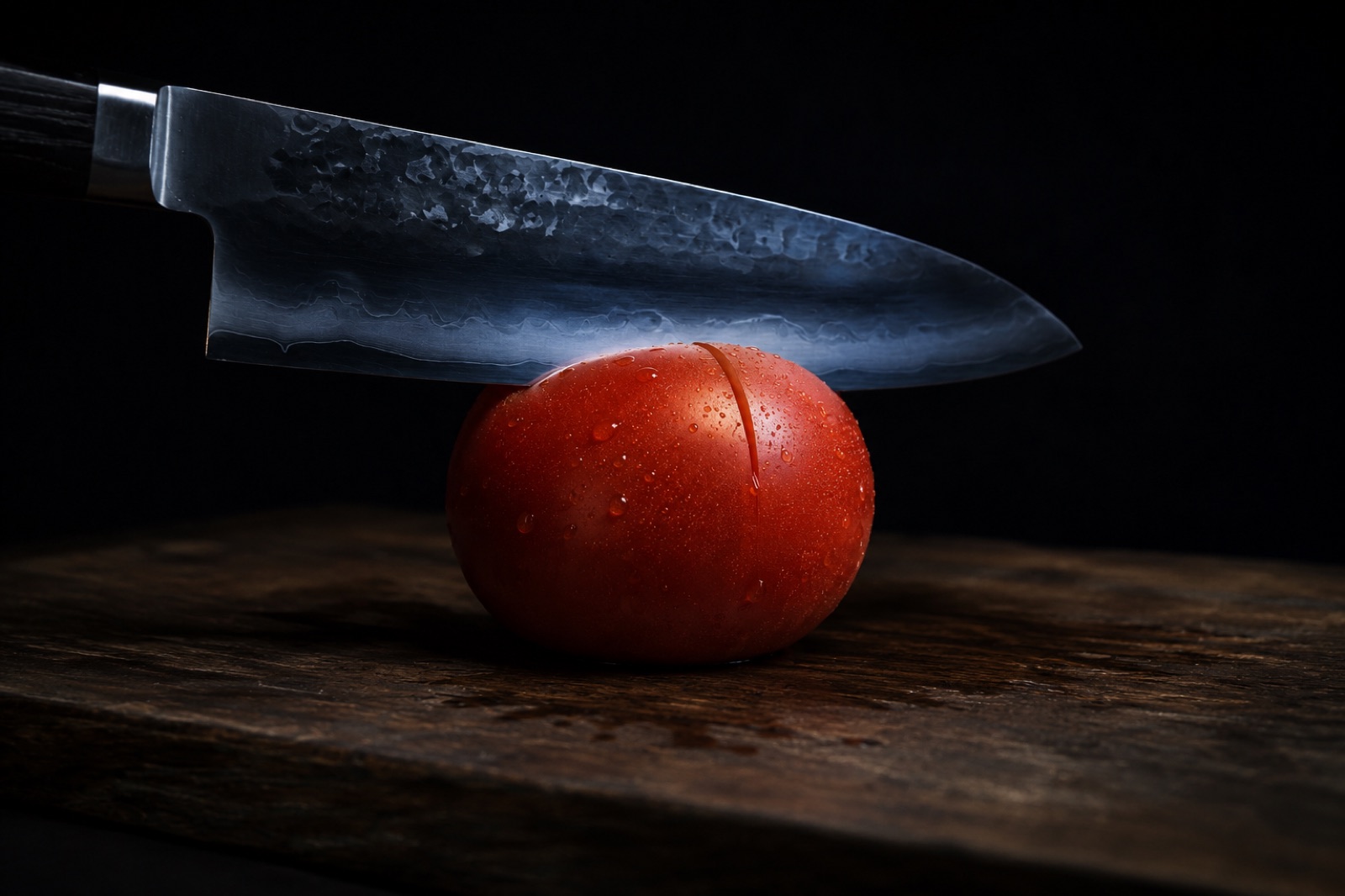
The first time you use a genuine Japanese knife, one thing tends to stop you: it slides through a ripe tomato and leaves a slice so thin it’s almost see-through — no crushing, no sawing. A lot of people first notice this in a video and think, this is nothing like the knife in my drawer.
But why is it so sharp? “Because it’s Japanese” isn’t an answer. The real reason is a stack of things working together: hard steel, a thin edge, careful heat treatment, hand-finished sharpening — and blade-making traditions that go back a thousand years. Here’s how it actually works, based on Japanese-language primary sources.
People also search variations like “why Japanese knives are so good” or “the best.” The useful answer is the same stack — not nationality as a magic label: honest hard steel, a thin edge, proper heat treatment, and finishing. “Best” depends on how you cook and care for the knife; hardness alone is the wrong scoreboard.
Reason 1: Hard steel — but the hardness number alone doesn’t decide quality
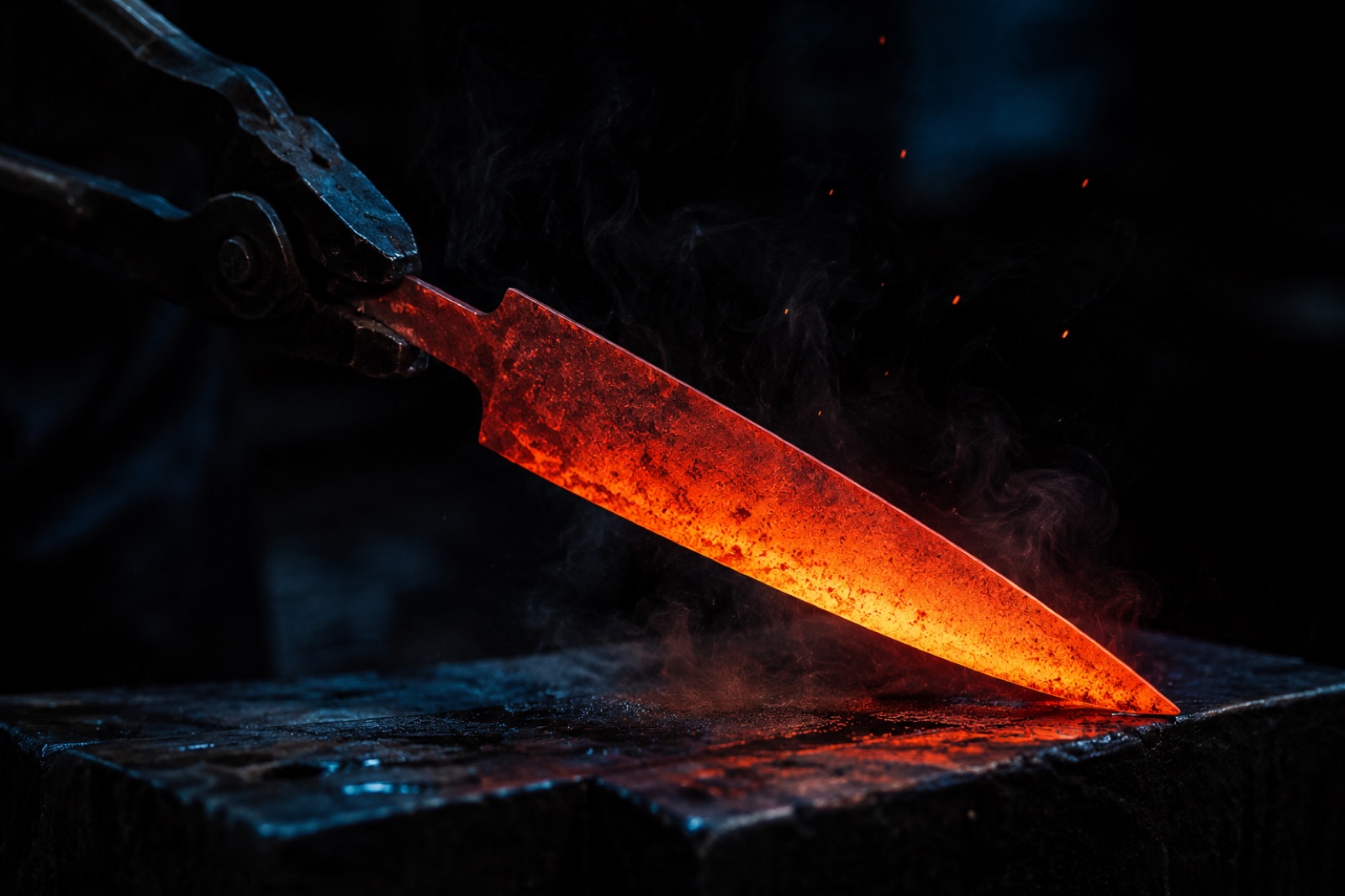
Most Japanese knives use harder steel than typical Western knives, because a harder edge tends to hold its sharpness longer. As a rough guide by steel type — per Tojiro’s own materials guide — White steel (Shirogami) runs about HRC 60±1, Blue steel (Aogami) about HRC 64±1, ordinary stainless about HRC 52±1, and molybdenum-vanadium stainless about HRC 56±1.
But here’s the trap in “harder is better.” According to Masahiro’s own guide to knife hardness, good, high-carbon steel given proper heat treatment becomes hard and tough, so it stays sharp for a long time. Even cheap, low-carbon steel, however, can be pushed to a high hardness number by manipulating the heat treatment — and in that case the carbides grow coarse, which actually worsens cutting and invites chipping or cracking. In other words, the enemy isn’t hardness itself — it’s fake hardness forced onto poor material. Hardness is a useful guide, but choosing on the number alone is risky; what matters is good steel, properly finished by a maker you trust. The same source gives typical hardness targets of around HRC 57–59 for home knives, HRC 59–62 for professional Western-style knives, and HRC 60–65 for professional Japanese-style knives.
So for your first knife, the question isn’t “is it the hardest?” but “is it good steel, properly finished, and matched to how you cook?” For an everyday kitchen, an easy-to-live-with stainless blade — rust-resistant and simple to touch up — is the safe pick.
Reason 2: A thin edge, fine carbides, and proper heat treatment
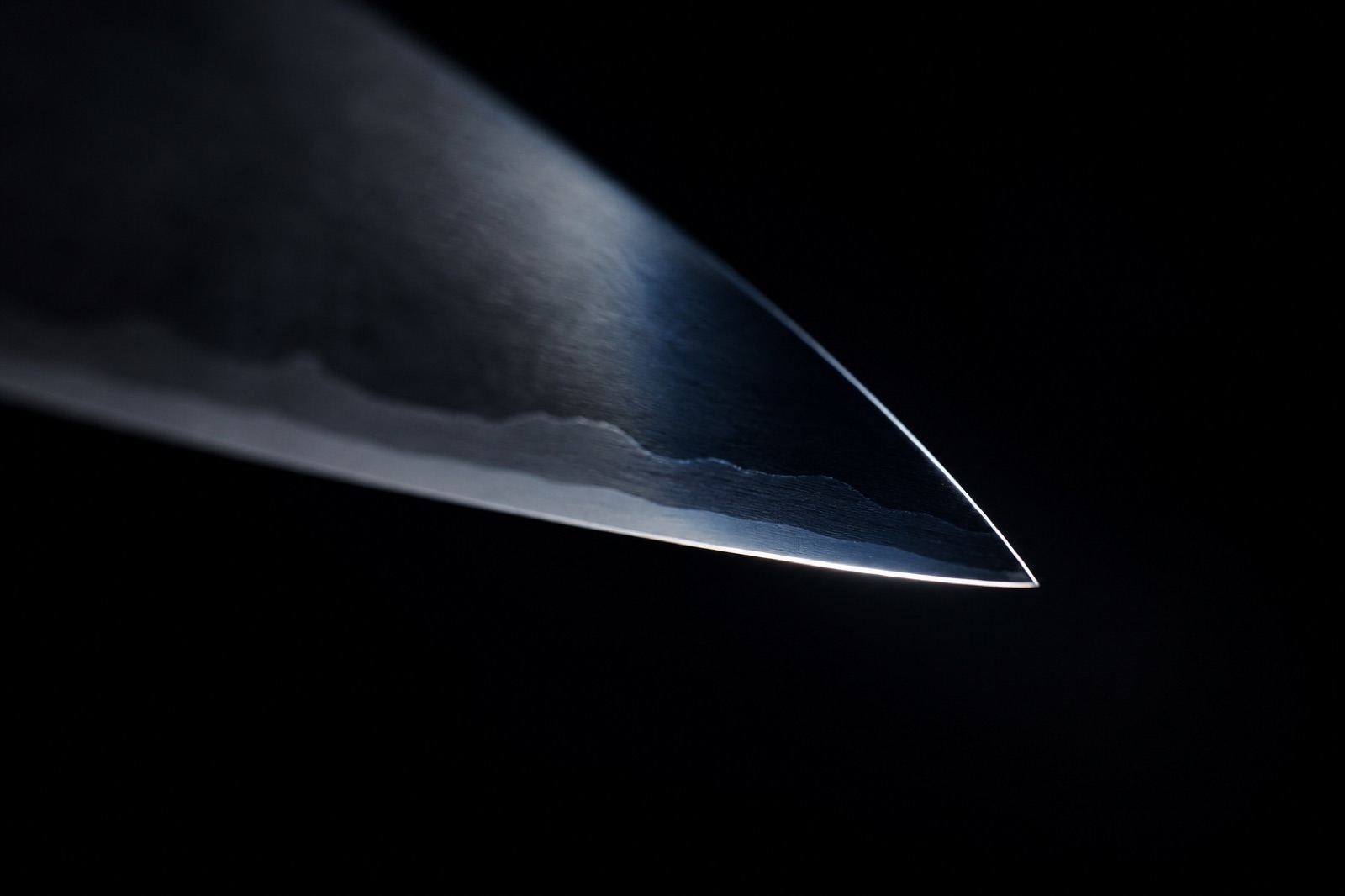
Sharpness isn’t only about hardness. Good high-carbon steel, given proper heat treatment, becomes both hard and tough — so the edge stays sharp far longer. Special steels like molybdenum-vanadium and powdered steel go further, precipitating many fine, hard carbides that keep the very edge fine-grained.
Geometry is the other half. As a general tendency, Japanese blades are thinner and ground to a more acute edge (this is a broad regional tendency; the exact thickness and edge angle vary by model), so they enter food with less force and are less likely to crush the cut face. It’s precisely because the steel is hard that this thin, keen edge can hold up.
Carbon steel vs. stainless
- Carbon steel (White/Blue): the sharpest and easiest to sharpen, but it rusts. Best if you enjoy maintenance.
- Stainless (VG10, molybdenum-vanadium, etc.): rust-resistant and forgiving — the safer choice for a first knife.
One famous attempt to get both at once is the “DP process” (an internal-decarburization-prevention method) developed by Tojiro in Tsubame-Sanjo. It bonds stainless to a core steel without degrading the core’s cutting properties, giving you sharpness and rust resistance in one blade. That’s why so many Japanese knives are “clad” (three-layer) construction.
Reason 3: A thousand years of blades — from swords to kitchen knives
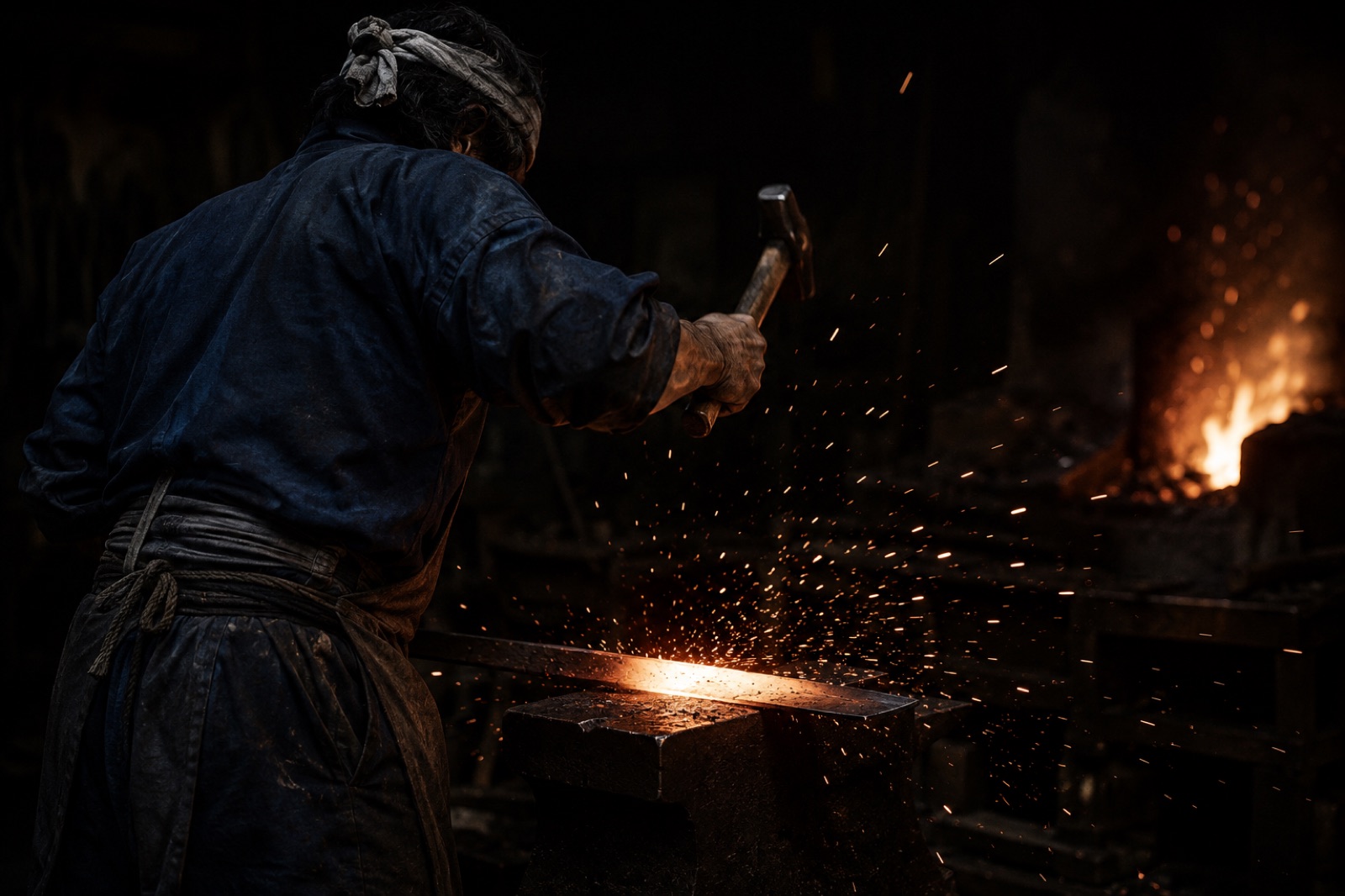
The sharpness of Japanese knives is, quite literally, a continuation of Japanese sword-making — and this is the part overseas makers can’t easily copy. (We go deeper on that lineage, and where the marketing oversells it, in From Sword to Kitchen Knife.)
Seki (Gifu) has forged blades since sword smiths set up there in the 13th century, drawn by good clay, pine charcoal, and the rivers Nagara and Tsubo. By the late Muromachi period, the smith known as Magoroku (the second-generation Kanemoto) had developed a forging method that produced swords famous for being “un-breaking, un-bending, and sharp.” When demand for swords fell in the Edo era — and after the Meiji-era sword ban — those smiths turned their metallurgy to small knives, kitchen knives, and scissors. Today Seki stands with Solingen (Germany) and Sheffield (England) as one of the world’s three great blade towns.
Sakai (Osaka) has its own arc — according to the city of Sakai’s own account: from 5th-century earthworking tools, to matchlock-gun production in the warring-states era, to Edo-period tobacco knives prized for “cutting well and lasting long” — the origin of its kitchen knives. Sakai’s edge is its division of labor: separate specialists for forging, sharpening, and handle-fitting, each mastering one craft. The sharpening step, where a chisel is used to remove subtle warping, is unique to Sakai. Sakai forged blades were designated a Traditional Craft in 1982.
A note on honesty: not every knife maker is a direct descendant of sword smiths. What’s true is that the Seki and Sakai regions as a whole inherited the metallurgy and craft culture of sword-making. Where we tell a specific brand’s lineage, it’s only what we could confirm in that company’s own sources.
Important: “Japanese steel” and “Made in Japan” are not the same thing
The mistake first-time buyers make most: labels like “Japanese steel” or “Japanese-style” do not mean the knife was made in Japan. Some knives use imported Japanese steel but are manufactured elsewhere. If you want a genuine Japanese knife, check that the region (Sakai, Seki, Tsubame-Sanjo…) and the maker are clearly named. (We break down how to spot the real thing in a separate guide.)
The takeaway
Japanese knives cut beautifully not “because they’re Japanese,” but because of a stack: the right hardness of good steel × a thin, keen edge × proper heat treatment × hand-finished sharpening × a thousand years of regional craft. And for a home kitchen, the blade that stays enjoyable the longest usually isn’t the hardest one — it’s the one matched to how you cook and care for it.
What to read next
- Reading a listing that says “Japanese”? Start with What Does “Japanese” Mean on a Kitchen Knife? — origin, steel, and style are different claims.
- Choosing a first shape? See Gyuto vs Santoku: How Japanese Makers Frame Your First Knife — how makers frame the two all-purpose profiles.
Sources
- Masahiro Co., Ltd. — The secrets of knife hardness (Japanese; confirmed July 26, 2026)
- Tojiro Co., Ltd. — Types of knife materials (Japanese; confirmed July 26, 2026)
- Seki Tourism Association — Seki cutlery and swordsmith history (Japanese; confirmed July 26, 2026)
- Nagoya Japanese Sword Museum Nagoya Touken World — Mino-den and Seki City (Japanese; confirmed July 26, 2026)
- Sakai City — Sakai forged blades (Japanese; confirmed July 26, 2026)