Buying Guides
What Does "Japanese" Mean on a Kitchen Knife?
When the page says “Japanese,” what is it pointing at?
Open an English product page for a kitchen knife and you will meet the word Japanese early — in the title, the bullet list, or both. The word does work. It also does three different jobs, and listings rarely say which job they mean.
Sometimes it means the knife was made in Japan. Sometimes it means the steel (or a steel story) is Japanese — or, confusingly, Swedish or European steel sold under a “Japanese knife” headline. Sometimes it only means Japanese-style: a shape, a bevel habit, a wa-handle cue, or marketing that sounds Japanese while manufacture sits elsewhere.
Shoppers already feel the gap. Is this actually made in Japan, or is it a “Japanese-style” knife made somewhere else? That anxiety is real. It is not the same claim as “everyone searching for Japanese-style knives is hunting a fake.” Style language and manufacturing location are separate facts; listings often put both on the same page.
This article answers one question: when a page says Japanese, can you tell whether it means origin, steel, or style — and verify the origin part before you buy? It is not a philosophy of authenticity. It is a commercial reading habit, built so you can clear that anxiety and then move on to choosing a knife.
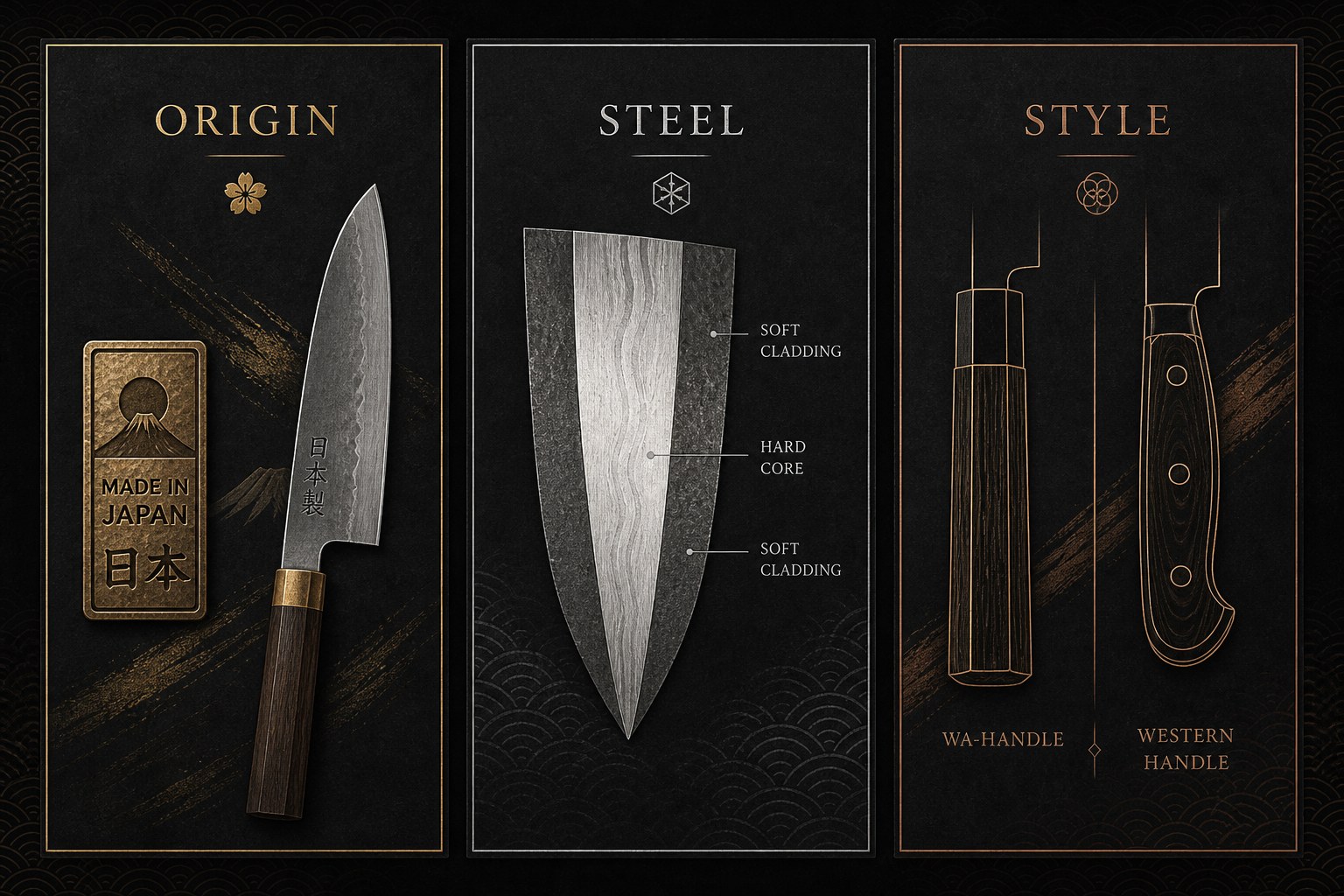
Three meanings: origin, steel, or style
Almost every confusing listing collapses into one of three claims. Keep them on separate lines. That separation is the answer to the H1.
1. Origin — Made in Japan / 日本製 / 国産
These are country-of-origin statements. They claim where the finished knife was produced as a knife — not where the marketing story is set. Under Japanese fair-labeling practice (see the next section), explicit wording such as Made in Japan, 日本製, or 国産 is the wording Japanese labeling criteria treat as an express statement of domestic production. For a shopper, that is the line to look for — and its absence is the signal that origin has not been stated at all. If a page never says any of that and only says “Japanese,” the clearest origin signal is missing.
2. Steel — Japanese steel / Swedish steel / EU steel
Steel origin and knife origin are not the same claim. A blade can use steel sourced or produced outside Japan and still be manufactured as a knife in Japan. A line that says “Japanese steel” does not, by itself, prove the finished knife is Made in Japan. The reverse is also true: foreign steel on a Made-in-Japan knife is not a scandal by default — it is a second fact next to origin.
3. Style — Japanese-style / Japanese design / Japanese profile
Style language describes shape, geometry habits, handle cues, or positioning. It can be accurate for a knife made anywhere. It does not substitute for Made in Japan. Reading “Japanese-style” as proof of Japanese manufacture confuses style language with manufacturing location — without pretending every style listing is fraud.
Once you can name which of the three a sentence is doing, most product-page fog thins. The rest of this article supports that reading: how Japan defines origin in labeling rules, how region names work as secondary clues, what to check before you pay, and how we apply the same split on knives we already document.
What “Made in Japan” means under Japanese rules
For the origin meaning above, Japanese primary sources are unusually clear.
A 1973 Japan Fair Trade Commission public notice (No. 34), now administered by the Consumer Affairs Agency, defines “country of origin” as the country where an act that substantially changes the content of the goods took place. That is the spine of the origin claim — not vibe, not packaging art.
The same notice treats origin confusion as two-sided. For goods produced abroad, displays that lean on a different country’s name, a business name foreign to the true origin, or mostly Japanese-language text can be improper when consumers cannot tell where the goods were actually produced. Japan’s own rules, in other words, treat a Japanese-looking presentation on a foreign-made good as an origin problem rather than a style question.
Related operational criteria add two buyer-useful points. First, for a domestically produced good, a display that would otherwise look confusing can fall outside the improper-display category when domestic production is stated outright — 国産, 日本製, a maker name with a Japanese plant, or a conspicuous Made in Japan. The criteria add a limit: if origin is still ambiguous after that, the foreign name’s relation to the goods has to be spelled out in Japanese as well. Second, acts that do not count as a “substantial change” include labeling, packaging, simple bundling, and simple parts assembly. Sticking a new seal or wrapping a box is not, under these criteria, enough to move country of origin.
One limit: the detailed operational rules list category examples (food, apparel, watches, and others). There is no kitchen-knife-specific row. For knives, the fair reading is the general definition — so the general definition is what applies.
Jurisdiction note: this is Japan’s framework for labeling shown to consumers in Japan; import-country duties — U.S. rules among them — are a separate track this article does not address.
Region names help — they don’t replace Made in Japan
Seki, Sakai, and Tsubamesanjo show up constantly in English copy. Each name is a secondary clue for the origin meaning. None replaces an explicit Made in Japan (or equivalent) line.
Seki (Gifu) — place-name misuse, scoped
The Gifu Prefecture Seki Cutlery Industrial Association has warned about online ads that use phrases such as “cutlery town Seki City, Gifu” or “Seki cutlery” for blades that were not manufactured in Seki City, calling those cases possible malicious mail-order sites. Scope that warning tightly: it is about misusing Seki’s place name for non-Seki manufacture. It does not declare every Japanese knife made outside Seki City to be fake. Seki’s own materials also describe the city among major cutlery producers and place cutlery technique in a sword-era craft story — the association’s self-description, not a bloodline test for every modern kitchen knife. For the boundary between sword history and kitchen knives, see From Sword to Kitchen Knife.
Sakai (Osaka) — trademark ≠ universal proof
The Federation of Sakai Cutlery Commerce and Industry Associations states that 「堺打刃物」 and 「堺刃物」 are registered trademarks of the federation (regional brand confirmed 5 October 2007), covering knives and scissors produced in Osaka City, Sakai City, and surrounding areas by methods originating in that region. Sakai uchihamono is also described on the federation site as a Traditional Craft, with named techniques, materials, and production area. Useful clues — and limited. Trademark presence is not automatic proof that every Sakai-adjacent marketing phrase is covered, and absence of the mark does not, by itself, prove a knife was not made in the Sakai area.
Tsubamesanjo (Niigata) — industrial Japan is still Japan
Domestic factory-scale production is not the opposite of “Japanese.” TOJIRO Co., Ltd. presents itself as manufacturing in Niigata / Tsubamesanjo with integrated production. A related Fuji Cutlery wholesale catalog lists the Fujitora DP clad gyuto line with country of origin: Japan. The Tsubamesanjo Regional Industries Promotion Center independently describes itself as a local hub for metal western tableware, cutlery, and kitchenware — a regional cross-check that the district exists as an industrial cutlery center. A second brand mark used for a different sales channel, and domestic factory-scale production, still sit on the origin line when the origin claim holds. Do not confuse them with overseas “Japanese-style” volume lines.
Explicit rule of thumb: region names help you ask better questions. They do not replace Made in Japan.
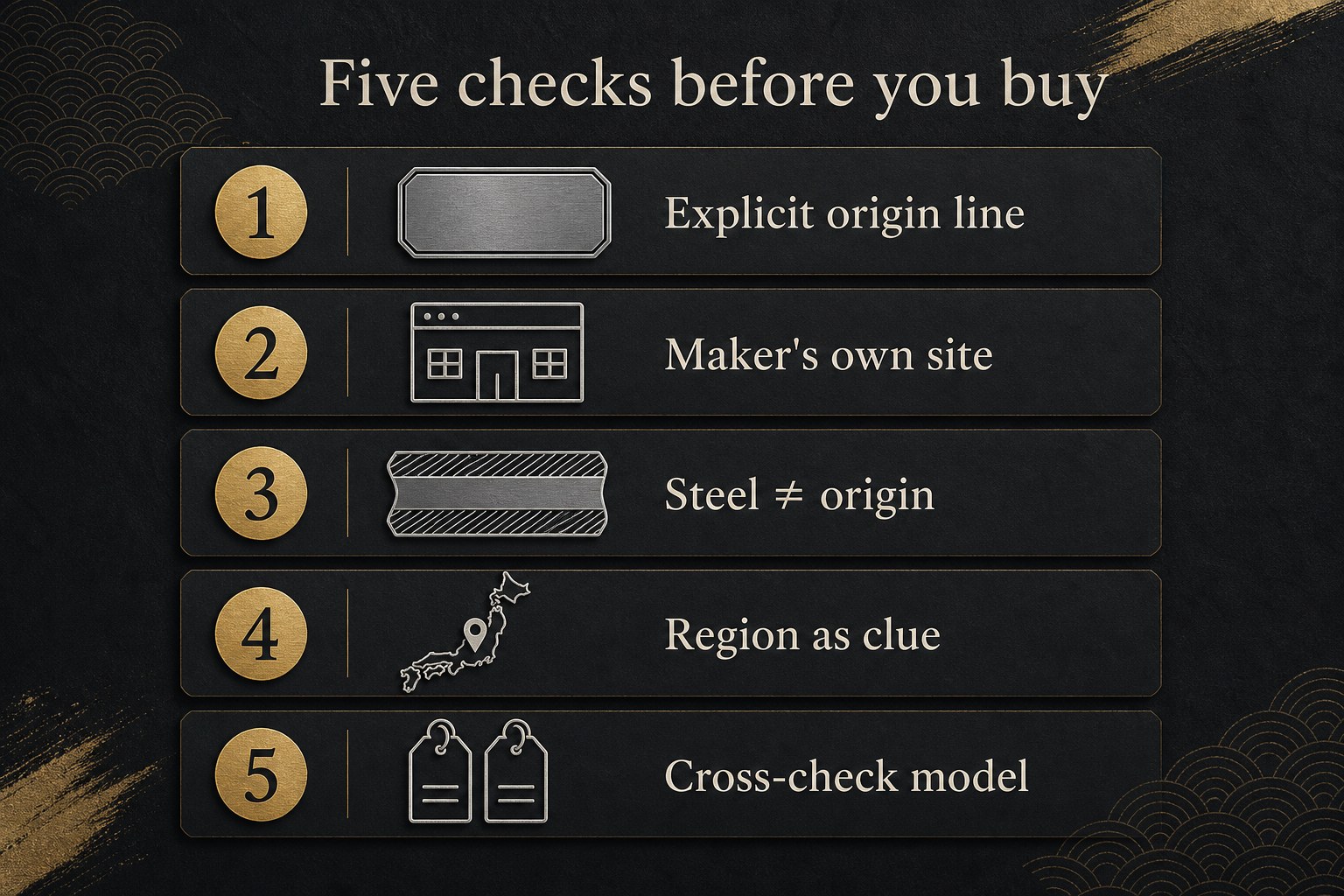
Five checks before you buy
You can run these without unboxing anything. Prefer primary pages over marketplace adjectives. Each check serves the same split: origin vs steel vs style.
- Find an explicit origin line. Made in Japan, 日本製, 国産, or a catalog field that states country of origin. “Japanese knife” alone is not the same claim.
- Open the maker’s own site (or the regional association), not only the marketplace card. Confirm a company name, a Japanese address or region, and that the model family exists on a Japanese-language maker or wholesale page.
- Separate steel wording from origin wording. If the page says Swedish / EU / Japanese steel, ask the second question: where does it say the knife was made?
- Treat region names as clues with known failure modes. Seki’s association has flagged ads that borrow Seki town branding for non-Seki manufacture. Sakai’s federated trademarks and Traditional Craft definitions are strong when present — not a universal pass/fail for every Sakai-adjacent phrase.
- Cross-check model numbers across maker, wholesale, and retailer. Matching SKUs and shared material sheets beat vibes. Prefer sellers who can name the manufacturer in Japan over copy that only says “Japanese craftsmanship.”
How we read examples on this site
The same three-way split is how we read knives we already document. These pages are worked examples of label reading, not a ranking.
- Misono UX10 — EU-sourced stainless in the steel story; Seki, Gifu manufacture in the maker story. Steel origin ≠ knife country of origin. Read both lines; do not collapse them.
- Tojiro DP Gyuto / Fujitora — Tsubamesanjo manufacture, integrated-production claims, wholesale country of origin: Japan, and a domestic industrial / wholesale mark that is still Japanese manufacture when the origin claim holds — not a “fake” because it is not a tiny forge narrative.
When we shortlist knives for this site, one practical gate is whether we can confirm Japanese manufacture from maker or catalog sources. We could not confirm Japanese manufacture for some of them, so they are not on the site.
Craft context without turning nationality into the whole answer: Why Are Japanese Kitchen Knives So Sharp?. Sword-era regions without lineage dogma: From Sword to Kitchen Knife.
What to read next
- Choosing a first shape? See Gyuto vs Santoku: How Japanese Makers Frame Your First Knife — how makers frame gyuto and santoku as sibling all-purpose profiles.
- Want the craft stack behind “so sharp / so good”? Read Why Are Japanese Kitchen Knives So Sharp?.
- Worked maker examples of the same split: Misono UX10 (steel story vs Seki manufacture) and Tojiro DP Gyuto (Tsubamesanjo / dual mark, still Japan when origin holds).
Sources
- Consumer Affairs Agency (Japan) — Public Notice on Misleading Representations Concerning the Country of Origin of Goods (FTC Public Notice No. 34 of 1973) (Japanese; confirmed 2026-09-05)
- Consumer Affairs Agency (Japan) — Operational Criteria for the Notice on Misleading Country-of-Origin Representations (Japanese; confirmed 2026-09-05)
- Consumer Affairs Agency (Japan) — Detailed Operational Rules on the Definition of Country of Origin (Japanese; confirmed 2026-09-05)
- Gifu Prefecture Seki Cutlery Industrial Association — Notice on misuse of Seki place branding in online ads (Japanese; confirmed 2026-09-05)
- Seki Cutlery — Tradition and technique (Japanese; confirmed 2026-09-05)
- Seki Cutlery — English top page (confirmed 2026-09-05)
- Federation of Sakai Cutlery Commerce and Industry Associations — On the trademarks 「堺打刃物」 / 「堺刃物」 (Japanese; confirmed 2026-09-05)
- Federation of Sakai Cutlery Commerce and Industry Associations — Traditional Craft introduction (Japanese; confirmed 2026-09-05)
- TOJIRO Co., Ltd. — company top page (Japanese; confirmed 2026-09-05)
- TOJIRO Co., Ltd. — company page (related company: Fuji Cutlery) (Japanese; confirmed 2026-09-05)
- Fuji Cutlery Co., Ltd. — Fujitora DP series catalog (incl. origin Japan) (Japanese; confirmed 2026-09-05)
- Tsubamesanjo Regional Industries Promotion Center — site (Japanese; confirmed 2026-09-05)
- Internal planning notes — reader authenticity anxiety; product-selection origin gate (site research; 2026)
- Live internal articles — Misono UX10, Tojiro DP gyuto, Why Japanese knives are sharp, Sword to kitchen knife (confirmed live 2026-09-05)