Craft & History
Japanese Knife Steel and Hardness: How to Read HRC, VG10, and Carbon vs Stainless
Introduction — Why steel labels matter on Japanese knives
English product pages for Japanese kitchen knives lean hard on three labels: an HRC number, a steel name (VG10 is the one that shows up most often), and a carbon vs stainless line. Those labels are useful — when you know what the maker who published them actually meant.
This article is a reading guide, not a ranking and not a cutting review. It sits under our craft piece Why Are Japanese Kitchen Knives So Sharp?, which explains the sharpness stack (steel, geometry, heat treatment, finishing). Here the job is narrower: decode the spec sheet vocabulary using Japanese-language primary pages from knife makers and a steel mill — Masahiro, Tojiro, and Takefu Specialty Steel — so you can tell a published guidepost from a SKU guarantee, and a steel-mill hardness from a finished-knife hardness.
If you came looking for “the hardest steel” or “the best VG10 knife,” that is the wrong scoreboard. Hardness alone is a poor buying guide; good steel, properly heat-treated and matched to how you cook and care for the knife, matters more — which is exactly the trap Japanese makers warn about in their own educational pages.
What HRC means (and what it does not)
According to Masahiro’s guide to knife hardness (Japanese), kitchen-knife hardness is usually evaluated on the Rockwell hardness C scale (HRC). On the C scale, a diamond indenter is used with a preliminary load of 10 kgf and a test load of 150 kgf. If the difference in indentation depth is h (mm), hardness is calculated as:
HRC = 100 − 500h
Masahiro’s example: when h = 0.084 mm, the result is HRC 58. The same page states the obvious industrial reading: the larger the number, the harder the steel.
That is what HRC is — an indentation-hardness index. What it is not is a quality score.
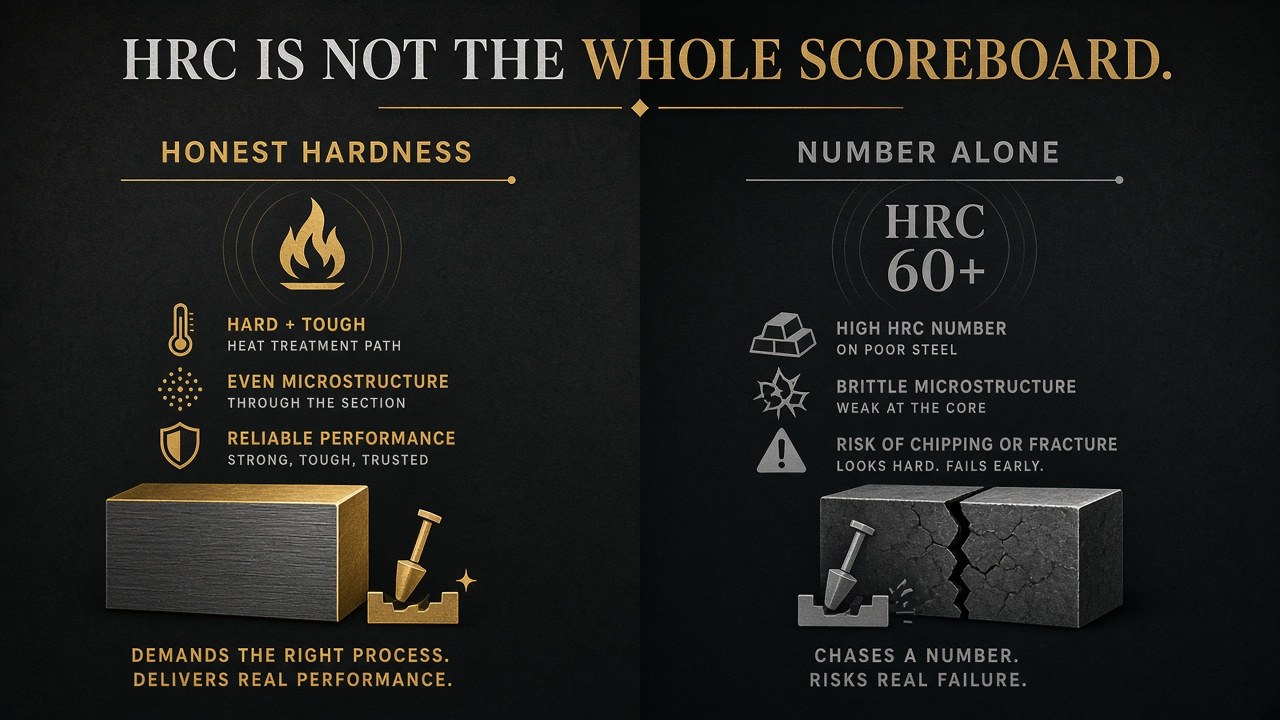
Masahiro is blunt about the trap shoppers fall into. People often treat hardness as if harder always means better; the company calls that a major pitfall. Even inexpensive, low-carbon material can be pushed to a high hardness number by manipulating heat treatment — and in that case carbides in the microstructure grow coarse, which can worsen cutting performance and invite chipping or cracking. Hardness is a useful guide, but judging a knife by the number alone is dangerous. What Masahiro describes as the conditional good case is high-carbon material given proper heat treatment: hard and tough, so sharpness lasts.
A related Masahiro page on what makes a good knife (Japanese) repeats the same limit in quieter language: composition tables and hardness numbers are references, not enough by themselves to decide.
Hardness and toughness are a pair (heat treatment in brief)
Hardness is set partly by quenching and tempering. On Masahiro’s heat-treatment page (Japanese), quenching is described as heating steel above its transformation point, then cooling it rapidly in water or oil to raise hardness and strength. As rough guides for that maker’s explanation — not universal rules for every factory — stainless steels are said to sit around 1,050°C, and carbon steels (hagane) around 800°C, because transformation temperatures differ with composition.
A hard edge alone chips and cracks easily. Tempering is the step that restores toughness (nebari). Masahiro writes that knives are expected to sacrifice a little hardness if that keeps the blade tougher and easier to sharpen. As an example of that company’s low-temperature tempering process — attributed to Masahiro, not generalized as industry law — the page describes heating quenched (and sub-zero-treated) steel at about 180°C for around one hour, then cooling slowly.
Takeaway for a product page: an HRC figure without a named maker, a named steel, and a credible heat-treatment story is incomplete. The number is a measurement; it is not the whole knife.
Hardness ranges Japanese makers publish as guideposts
Two Japanese makers publish ranges that English listings often treat as absolute. Read them as guideposts the maker chose to publish, not as warranties for every SKU on every marketplace card.
Masahiro’s use-category bands
On the same hardness page, Masahiro presents typical hardness bands for knives “as in the table on the left”:
| Maker category (Masahiro wording) | HRC band |
|---|---|
| Inexpensive knives | 52–56 |
| General household knives | 57–59 |
| Professional Western-style knives | 59–62 |
| Professional Japanese-style knives | 60–65 |
These are category guideposts, not a claim that your specific model was measured to the edge of a band. Masahiro’s own warning still applies: hardness is a guide; hardness alone is a risky way to choose.
Tojiro’s steel-type hardness standards
Tojiro’s materials guide (Japanese) publishes in-house hardness standards by steel type. The company writes that it uses roughly:
| Steel type (Tojiro guide) | Published hardness standard |
|---|---|
| Ordinary stainless cutlery steel | HRC 52±1 |
| Molybdenum-vanadium steel | HRC 56±1 |
| Cobalt alloy steels and similar | HRC 58±1 |
| White steel (shirogami) — table | HRC 60±1 |
| Blue steel (aogami) — table | HRC 62±1 |
Editing note on Blue steel: on the same Tojiro page, an introductory sentence also mentions Blue steel around HRC 64±1, while the materials table lists 62±1. Those are two expressions on one page — do not collapse them into a single “true” Blue-steel HRC. Cite which line you mean, or keep both as page-internal variation.
Editing note on Mo-V: on the same Tojiro page, the introductory hardness list cites molybdenum-vanadium steel at HRC 56±1, while the materials table lists Mo-V at HRC 58±1. Same page-internal split pattern as Blue steel — do not collapse them; cite which line you mean.
White / Blue steel appear here only as a map tile: Tojiro presents them as grades in the Yasugi-style carbon-steel family (Yellow → White → Blue). This article’s focus stays on how to read HRC and VG10; we do not deep-dive those carbon grades here.
Critical reading rule: a guidepost from a maker’s education page is not the same thing as a measured HRC printed for one SKU on a retail listing. If a marketplace card shows a hardness number and you cannot find the same number on the knife maker’s product page (or the steel mill’s datasheet for the steel itself), treat it as unverified marketing — and do not treat this craft guide as filling that gap. We do not invent per-SKU HRC figures.
How to read a steel name: VG10 (V-Gold 10) as a worked example
VG10 (Japanese: V金10 / V-kin 10) is a useful worked example because English listings use the name constantly — and because the steel mill and a knife maker publish different hardness numbers for related but non-identical claims. Keeping those layers apart is the whole point of this section.
Primary source: Takefu Specialty Steel
Takefu Specialty Steel’s VG10 / V-Gold 10 page (Japanese) is the primary definition for the steel itself. Takefu describes V-Gold 10 as its original cutlery steel, strengthened in the matrix by additions including roughly Cr 15%, Mo 1%, and Co 1.5%, aiming at high hardness and longer edge holding. Vanadium (V) is described as refining the microstructure and further improving wear resistance; machinability is called good, so sharpening is relatively easy; corrosion resistance and cutting performance are both part of the pitch.
Takefu publishes representative chemical composition and quenched hardness as typical data for the grade’s specification (the site notes that listed chemistry values are representative data within the grade’s specs — not a promise that every finished knife measures identically):
| Element / property | Takefu representative value (VG10 / V-Gold 10) |
|---|---|
| C | 1.00 |
| Cr | 15.00 |
| Mo | 1.00 |
| V | 0.25 |
| Co | 1.55 |
| Quenched hardness | HRC 60 or higher |
That HRC ≥ 60 line is a steel-mill quenched-hardness figure for the grade. It is not automatically the Rockwell number stamped on every finished VG10 kitchen knife after that maker’s quench-and-temper cycle.
Takefu also warns that internet retailers sometimes advertise look-alike or imitation products as if they used Takefu’s original VG10 / V-Gold 10. The steel maker asks buyers to be careful. For shoppers, that is a cue to prefer listings that name a knife maker you can verify — and, when steel origin matters to you, a steel story that can be checked against a mill or maker page — rather than the bare string “VG10” alone.
Secondary: how knife makers introduce VG10
Knife-maker pages are secondary for the steel’s definition, and useful for how finished products are positioned.
- Tojiro’s materials guide introduces V-Gold 10 as a special stainless cutlery steel. Tojiro’s own wording compares it to carbon steel (hagane): somewhat behind on cutting performance, but relatively strong against rust, and — in Tojiro’s phrase — among the more suitable materials for knives. In Tojiro’s hardness table, VG10 is listed at HRC 58±1. That is Tojiro’s published product-hardness standard for that row — not Takefu’s quenched-hardness line rewritten.
- Tsukiji Masamoto’s product-types page (Japanese) states that for Western-style knives the company mainly uses Takefu’s V1 and V-Gold 10 steels, and describes V-Gold 10 as a stainless with relatively high carbon that can approach carbon-steel cutting feel — that maker’s positioning language, not a universal ranking.
Do not collapse Takefu ≥60 and Tojiro 58±1
| Claim layer | Who says it | Number | What it measures |
|---|---|---|---|
| Steel grade, quenched hardness (representative) | Takefu Specialty Steel | HRC 60 or higher | Mill datasheet for the steel after quench (representative) |
| Knife-maker hardness standard for VG10 row | Tojiro | HRC 58±1 | Tojiro’s in-house product hardness target in its materials guide |
These are different layers. Finished hardness depends on heat treatment; makers choose targets for toughness, sharpenability, and their own process. Treating “Takefu says ≥60, so every VG10 knife is 60+” — or “Tojiro says 58±1, so Takefu is wrong” — collapses two documents that are not answering the same question.
What this article does not do: invent per-SKU HRC for any VG10 gyuto or santoku. If a retail card shows a hardness and the knife maker’s product page does not, leave that number out of your decision — or verify it first.
FAQ — What HRC is VG10, and how to read hardness
VG10 hardness is not one marketplace number. The steel mill and a knife maker can both publish real figures that answer different questions.
Two hardness layers at a glance
| Layer | Who publishes | Published figure | What the figure is |
|---|---|---|---|
| Steel grade, quenched hardness (representative) | Takefu Specialty Steel | HRC 60 or higher (JP: 焼入硬度 HRC60以上 / EN: HRC60≦) | Mill datasheet for the grade after quench — not every finished knife |
| Knife-maker product hardness standard (VG10 row) | Tojiro | HRC 58±1 | Tojiro materials-guide in-house target for that row — not Takefu rewritten |
Not a ranking and not a SKU guarantee. Finished hardness depends on heat treatment. Do not average these layers; do not treat either as wrong. Sources: Takefu V-Gold 10 (JP), Takefu VG10 (EN), Tojiro materials guide (VG10 table row).
What HRC is VG10?
There is no single universal finished-knife HRC for every “VG10” listing.
- Takefu Specialty Steel (the mill for V-Gold 10 / VG10) publishes quenched hardness HRC 60 or higher as representative grade data (JP 焼入硬度 HRC60以上; EN HRC60≦).
- Tojiro’s materials guide lists VG10 (V金10号) at HRC 58±1 as that maker’s published product-hardness standard for the row.
Read them as two layers (mill quench vs maker product target), not as a fight. Do not invent a per-SKU HRC, and do not average 60 and 58±1 into one “true” number.
Why can Takefu say ≥60 and Tojiro say 58±1 without one being “wrong”?
They answer different questions. Takefu’s figure is steel-mill quenched hardness for the grade (representative within specs). Tojiro’s 58±1 is an in-house product hardness standard on a knife-maker education page. Finished hardness after quench-and-temper is a maker process choice (toughness / sharpenability / house target) — which Masahiro’s heat-treatment page frames as a hardness–toughness pair, not a single maxed number.
Collapsing “Takefu ≥60 ⇒ every VG10 knife is 60+” or “Tojiro 58±1 ⇒ Takefu is wrong” misreads both documents.
Does a higher HRC always mean a better knife?
No. Masahiro’s hardness page calls “harder = better” a major pitfall: inexpensive low-carbon material can be pushed hard by heat-treatment tricks, with coarser carbides and worse cutting / chipping risk. Hardness is a guide; judging by the number alone is dangerous. Composition plus proper heat treatment matter — the same limit appears on Masahiro’s “what makes a good knife” page.
What does HRC actually measure?
Per Masahiro: kitchen-knife hardness is usually evaluated on Rockwell C (HRC) — diamond indenter, preliminary load 10 kgf, test load 150 kgf, HRC = 100 − 500h (h = indentation-depth difference in mm). Example: h = 0.084 mm → HRC 58. A larger number is a harder index, not a quality score.
If a product card says “VG10,” is that Takefu’s VG10?
Not automatically. Takefu warns that internet sellers sometimes advertise look-alikes as if they used Takefu’s original VG10 / V金10 (VG10 page). Prefer a verifiable knife maker (and, when steel origin matters, a checkable mill/maker story) over the bare string “VG10.” This site does not certify any retailer listing; the warning is Takefu’s, surfaced in maker voice.
Does “stainless” mean the knife never rusts?
No. Tojiro’s science-of-steel page states stainless is rust-resistant, not rust-proof — care still matters. Makers also describe chromium thresholds differently (Tojiro 12%+ vs Masahiro 13%+); keep both lines rather than collapsing them (see Carbon vs stainless below).
Where should I go next after reading hardness?
- Shape decision → Gyuto vs Santoku
- Worked product reading (illustrations of maker copy, not hardness leaderboards) → Tojiro DP Gyuto / Misono UX10
- Sharpness stack parent → Why Are Japanese Kitchen Knives So Sharp?
Carbon vs stainless: the tradeoffs makers describe
English marketing often collapses this into “stainless = no rust / carbon = always sharper.” Japanese maker education pages are more careful. Read their definitions at the granularity they publish — including where two makers draw the chromium line differently.
How Masahiro defines the materials
On Masahiro’s materials page (Japanese):
- Carbon steel (hagane): Masahiro writes that knives commonly use carbon steels with about 0.8–1.3% carbon.
- Chromium and the stainless label: chromium improves hardenability and corrosion resistance. Masahiro states that when 13% or more Cr is added, the steel is called stainless.
- Kitchen-knife stainless in general: roughly C 0.6–1.0% and Cr 13–16%. The stainless used for blades is the martensitic family that hardens by quenching. Common 18-8 / SUS304-type stainless does not harden by quenching and, per Masahiro, is not used for cutlery.
How Tojiro frames stainless — rust-resistant ≠ rust-proof
Tojiro’s “science of steel” page (Japanese) is the source for a sentence English buyers need:
Stainless for knives is iron whose composition has been adjusted to resist rust. It is a rust-resistant material, not a rust-proof material. Among stainless grades, those that contain enough carbon to be quench-hardenable are basically more prone to rust than non-hardenable stainless, so knives especially need care.
On the same page, Tojiro describes stainless as an alloy steel with 12% or more chromium added to improve steel’s tendency to rust.
Cr “12%” and “13%” — cite both; do not collapse
| Source | Chromium threshold wording |
|---|---|
| Tojiro — science of steel | Cr 12% or more (alloy steel framed as stainless) |
| Masahiro — materials | Cr 13% or more → “called stainless steel” |
Both are maker education pages, not a single international statute quoted here. Makers cut the explanation at slightly different percentages. This article keeps both lines and does not pick one as the absolute threshold.
Choosing by care and priority (Tojiro’s framing)
Tojiro’s knife-selection guide (Japanese) gives a practical fork without ranking steels:
- If you can care for the knife daily and prioritize cutting feel → carbon (hagane) family
- If you want easier care and less rust anxiety → stainless family
- If you want both strengths → composite / clad constructions
Clad (san-mai / DP-style) knives are a map tile here, not a product pitch: makers use stainless cladding over a harder core precisely to balance care and edge behavior. For how that stack sits inside the larger sharpness story, see Why Are Japanese Kitchen Knives So Sharp?.
A practical reading checklist for product pages
Use this before you treat a listing’s steel story as settled. No unboxing required.
- Who published the HRC? Prefer the knife maker’s product or education page, or the steel mill’s datasheet for the grade. A marketplace adjective without a named source is the weakest form of the claim.
- Is the steel name tied to a maker or mill you can open? “VG10” alone is thinner than “VG10 / V-Gold 10 per Takefu” plus a knife maker you can verify. Takefu’s own imitation warning is a reminder that the string travels farther than the mill’s control.
- Separate steel-mill hardness from finished-knife hardness. Takefu’s HRC ≥ 60 quenched figure for VG10 and Tojiro’s HRC 58±1 product standard are both real published numbers — for different layers. Do not average them; do not pick a fight between them.
- Read carbon vs stainless as a care tradeoff, not a morality play. Masahiro and Tojiro both describe stainless as corrosion-resistant with limits; Tojiro explicitly rejects “does not rust.” Carbon families ask for more maintenance; that is a lifestyle fit, not a purity test.
- Do not let HRC be the whole comparison. Masahiro’s hardness and “good knife” pages both say composition and hardness are references — not enough alone. Match steel and care to how you cook; then choose shape (gyuto vs santoku) and origin claims separately.
Optional product pages on this site are illustrations of how to read maker copy, not rankings and not hardness leaderboards: Tojiro DP Gyuto (Tsubamesanjo maker family; read materials and channel labels on the maker’s terms) and Misono UX10 (Seki maker; published stainless positioning and maker-stated hardness where the maker publishes it).
What to read next
- Sharpness stack (parent craft piece): Why Are Japanese Kitchen Knives So Sharp? — steel, geometry, heat treatment, and regional craft without treating nationality as magic.
- When the listing says “Japanese”: What Does “Japanese” Mean on a Kitchen Knife? — origin, steel story, and style language are different claims.
- First shape, not first steel ranking: Gyuto vs Santoku: How Japanese Makers Frame Your First Knife — maker framing for the two all-purpose profiles.
Sources
- Masahiro Co., Ltd. — The secrets of knife hardness (Japanese; confirmed 2026-09-19)
- Masahiro Co., Ltd. — Knife materials (Japanese; confirmed 2026-09-19)
- Masahiro Co., Ltd. — On heat treatment (Japanese; confirmed 2026-09-19)
- Masahiro Co., Ltd. — What makes a good knife (Japanese; confirmed 2026-09-19)
- TOJIRO Co., Ltd. — Types of knife materials (Japanese; confirmed 2026-09-19)
- TOJIRO Co., Ltd. — The science of steel (hagane) (Japanese; confirmed 2026-09-19)
- TOJIRO Co., Ltd. — How to choose a knife (Japanese; confirmed 2026-09-19)
- Takefu Specialty Steel Co., Ltd. — V-Gold 10 (VG10) (Japanese; confirmed 2026-09-19)
- Takefu Specialty Steel Co., Ltd. — V-Gold 10 (VG10) (English; confirmed 2026-09-27)
- Takefu Specialty Steel Co., Ltd. — Original cutlery steels index (Japanese; confirmed 2026-09-19)
- Tsukiji Masamoto — Product types (Japanese; confirmed 2026-09-19)